Line Work Elements: A Typeface for Modern Minimalist Design
There’s a particular kind of elegance that comes from restraint. It’s the beauty of a single, confident brushstroke, the clean geometry of a hand-drawn line, the negative space that gives a design room to breathe. In a world saturated with complex graphics and layered textures, this minimalist approach feels both refreshing and timeless. For designers, achieving this refined look traditionally required painstaking hand-drawing or commissioning custom illustrations—a process that is both time-consuming and expensive. This is precisely where a specialized creative font like Line Work Elements becomes an invaluable part of a designer's toolkit.
Understanding the Single-Line Aesthetic
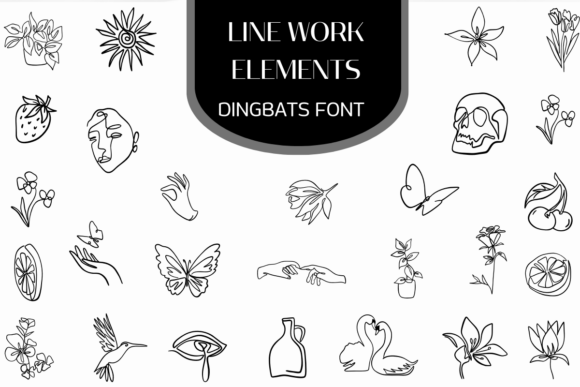
At its core, Line Work Elements is a premium dingbats font, but that simple classification hardly does it justice. Think of it less as a traditional typeface for setting text and more as a curated library of high-quality vector illustrations. Each character you type—from A to Z, numbers, and symbols—corresponds to a unique, hand-drawn graphic rendered in a continuous, ultra-thin line style. This isn't clip art; these are sophisticated, scalable vectors designed to integrate seamlessly into professional projects.
The visual language is distinctly modern. The collection includes a diverse range of motifs: delicate floral sprigs, abstract human faces and hands, elegant butterflies, and even artistic, stylized skulls. The consistent single-line weight creates a cohesive aesthetic across all the elements, ensuring they work together harmoniously. This style is reminiscent of contemporary logo design, minimalist illustration, and the fine-line artistry seen in high-end stationery and apparel. It provides that sought-after "hand-drawn" quality with the precision and scalability of digital assets.
Practical Applications Across Creative Fields
The true value of a design asset lies in its versatility. Line Work Elements shines because it can be deployed across a multitude of projects, adding a layer of sophistication without overwhelming the core message. Its applications extend far beyond a single niche, making it a practical choice for a wide range of creative professionals.
- Branding and Logo Design: Use a single element as an iconic mark within a logo, or as a secondary brand motif for business cards, letterheads, and packaging. The thin lines ensure clarity at small sizes, perfect for favicon and app icon designs.
- Editorial and Web Design: Create elegant section dividers, custom bullet points for lists, or decorative elements for blog post headers and pull quotes. In web design, these icons can enhance user interface elements or feature in hero sections without adding heavy file sizes.
- Social Media and Digital Marketing: Design distinctive Instagram highlight covers, create cohesive story graphics, or add artistic flair to email newsletter headers. The consistent style helps build a recognizable visual brand across all digital touchpoints.
- Packaging and Merchandise: From minimalist soap labels and coffee bag designs to apparel graphics and tote bag prints, these elements provide a high-end, artisanal feel. They work beautifully for both spot-color printing and single-color screen printing.
- Invitations and Print Collateral: This is where the font truly excels. Wedding invitations, event programs, and greeting cards gain an immediate air of elegance with floral borders, monogram frames, or decorative accents from the set.
Integrating Line Work Elements into Your Design Workflow
Adopting a new creative font effectively requires more than just installation. To get the most out of Line Work Elements, consider these practical steps for integration into your projects.
Choosing the Right Style and Pairing Fonts: The first step is to explore the full character map to understand the range of available illustrations. Does your project call for organic florals, geometric abstractions, or figurative icons? Select elements that align with your project's personality. Because Line Work Elements is a display font with a strong visual character, it pairs best with clean, neutral typefaces. A classic serif font like Garamond or a modern sans-serif like Montserrat or Helvetica Neue provides a perfect, readable counterpoint. Let the line work elements serve as the artistic accent, not the primary text.
Ensuring Readability and Professional Presentation: The thin lines of this typeface are its defining feature, but they also require consideration for final output. At very small sizes, especially in low-resolution print, these details can get lost or appear broken. Always test your designs at their intended scale and on the final medium—whether a business card, a website banner, or a t-shirt mockup. For digital use, ensure there's sufficient contrast with the background. For print, consider the paper stock; a thicker, uncoated paper can better hold fine detail than a glossy, thin sheet.
Leveraging for Visual Consistency and Brand Recognition: One of the most powerful ways to use a toolkit like this is to establish a consistent visual language. Choose two or three key elements from the font and use them repeatedly across all your brand materials. This could be a specific floral sprig as a recurring motif, or a set of abstract shapes used to frame images. This repetition builds subtle brand recognition, making your communications feel more polished and intentional. It transforms a simple social media graphic or a product hang tag into a piece of a larger, cohesive brand identity.
A Resource for Efficient, High-Quality Creation
For the small business owner designing their own packaging, the blogger creating custom graphics, or the designer working on a tight deadline, efficiency is key. Sourcing, commissioning, and editing custom illustrations for every project is rarely feasible. A well-crafted creative font like Line Work Elements acts as a powerful shortcut, providing a library of professional-grade design assets that are infinitely scalable and easy to edit. You can change the color, size, and orientation with a simple keystroke or a few clicks in your design software.
When evaluating any commercial font, always review the licensing terms to ensure they cover your intended use, whether for personal projects, client work, or merchandise sales. The goal is to find assets that not only inspire you creatively but also support your practical workflow and business needs. By incorporating versatile tools that offer both aesthetic appeal and functional flexibility, you empower yourself to produce cleaner, more sophisticated, and more engaging visual communication—ultimately helping your work, and the brands you build, stand out with quiet confidence.